What students say sociology gave them, opportunities for global connection, and where our graduates go to work…
Undergraduate Voices
“Being a student in the Department of Sociology has allowed me to explore my interests and gain valuable knowledge that I can use in my future career. My minor in criminology and criminal justice pairs very well with my major and enhances what I am learning in other classes. I have really enjoyed the classes I have taken within the department and am looking forward to taking more in the upcoming semesters!”
– Kaitlyn Casper, Class of '28 – International Studies major, Criminology & Criminal Justice minor; Social Media and Engagement Chair, Ohio State Sociology and Criminology Student Club
“Sociology at OSU has been valuable to me in more ways than I can fully express… I would start with the critical thinking skills the major instills in its students. Every class and assignment carries the expectation that students will not simply regurgitate information mechanically, but apply it to real-world contexts and continue learning through that application.”
– Merafe Endalew, Class of '26 – Sociology and African American and African Studies; thesis: “The narrative experiences of working poor individuals who experience downward mobility”
What can I do with a Sociology Degree?
Our graduates go on to law enforcement, public health, social services, data analytics, nonprofits, law firms, congressional offices, the Census Bureau, schools, and top graduate programs. The pre-graduation surveys from 2023-2025, administered by the Office of Student Life, report that 30% of our graduates work for a for-profit company, 20% work for a private non-profit organization, and 50% work in the government or for a public institution.
Classrooms Without Borders: Columbus Meets İzmir
In Spring 2026, Danielle Schoon (Assistant Professor of Teaching) taught a four-credit High Impact Practice section of SOC 3200, Sociology of Immigration, using COIL – Collaborative Online International Learning. The course offers a sociological understanding of contemporary migration globally and in the U.S.: why migration occurs, how it is sustained over time, and how immigrants are incorporated into a receiving society. The COIL component gave Dr. Schoon and her students the chance to collaborate online with peers at an international university, İzmir University of Economics (IEÜ) in Turkey.
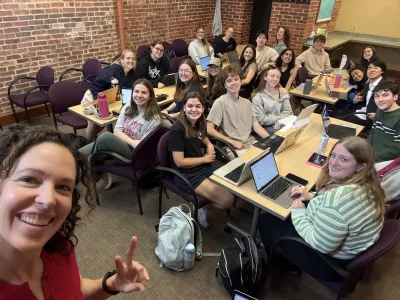
In partnership with Prof. Dr. Hatice Deniz Yükseker Tekin, 25 Ohio State students and 30 IEÜ students met six times over Zoom during the second half of the semester, forming small groups that also met on their own time. Each group chose an immigration-related topic and collaborated on the research, final report, and presentation, drawing comparisons between the United States and Turkey – or, more specifically, between Columbus and İzmir.
One group compared Afghan immigrant businesses on Bethel Road in northwest Columbus with Syrian immigrant businesses in the Basmane neighborhood of İzmir, and found that in both contexts migrants engage in placemaking, using affordable spaces to build support networks. As the students concluded, in both places immigrant communities turn underused or neglected urban spaces into lively neighborhoods filled with economic and social energy. Other groups examined migration among women, the mental health of immigrant youth, refugee policy, border security, media representations of immigrants, and the impact of political narratives on public perception.
Students reported that the seven-hour time difference and differing communication styles were real challenges – and that working through them was the point. They came away more aware of their own cultural assumptions and more practiced at intercultural collaboration. One student reflected:
“This project challenged my preconceived notion of success and made me reconsider how communication and expectations are different in different cultures. At the beginning I viewed a successful project as producing a clean, clear final report in which people split work within defined roles. I realized that success is not always defined that way, and the goal of COIL is not necessarily purely the report but the experience of the project. Maintaining group relationships and remaining flexible throughout the interactions actually taught me how to better approach teamwork.”
– Liam Johnson, Class of '26
Dr. Schoon has championed COIL at Ohio State for the past four years and recently led a COIL Learning Community of faculty, supported by the Office of International Affairs and the Drake Institute for Teaching and Learning. COIL is an accessible route to an international experience and to real gains in intercultural competence – and she will offer it again in Spring 2027.
Genocide and Its Aftermath in Rwanda, Study Abroad Program
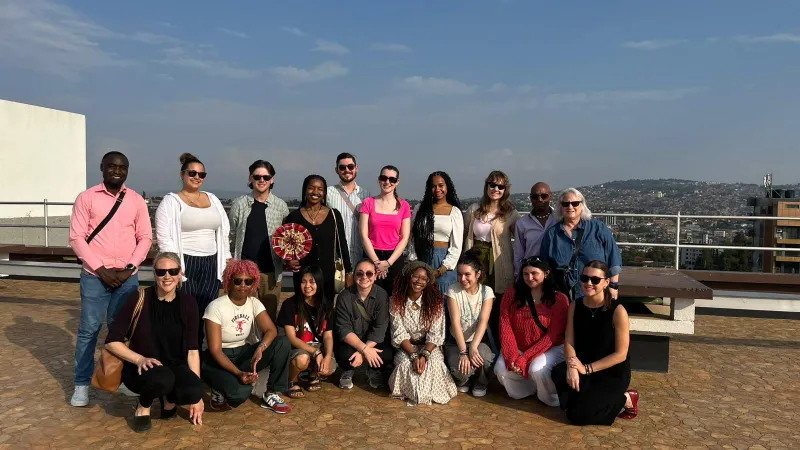
Professor Hollie Nyseth Nzitatira’s Genocide and Its Aftermath in Rwanda program offers students a transformative three-week learning experience in Rwanda each summer. Based in Kigali, the program combines academic study with direct engagement, giving students a deeper understanding of genocide, its long-term impacts, and the efforts to overcome its trauma. The opportunity welcomes students of any major in addition to our sociology and criminology students. The department supports participants through scholarships, with additional funding made possible by generous donor contributions. The seventh cohort made the trip this past May and June.
Over the program, students are based in Kigali but travel around the country. They spend time at the national university in an exchange with local students and visit genocide memorials, museums, government offices, survivor organizations, and women’s cooperatives – hearing testimony from people who were rescued during the genocide, those who survived it, and those who participated in the violence.
Students frequently report how impactful the experience is as well as how much they learned. Below are accounts from two of the Summer 2026 participants.
"Studying abroad in Rwanda was truly a life-changing experience. No matter how much you read about a conflict or country, nothing compares to being there firsthand, hearing from people who lived through it, and visiting the places where history unfolded. The program was exceptionally well-run and went far beyond traditional classroom learning. From visiting museums and memorials and connecting with Rwandan college students to hearing from leaders such as the Minister of Finance and Economic Planning, every experience connected what we studied to the people and communities we encountered. I left Rwanda with a deeper understanding of its history, resilience, and recovery with friends and memories that will last for life."
-Georgia Tsambis, Class of '27
"The program allowed me to grow on an academic, professional, and personal level, as I was confronted with challenging, but important questions about how genocide occurs and how countries can recover after mass atrocity. I learned how to approach such heavy topics with sensitivity, humility, and cultural awareness. The program also reinforced why studying genocide is essential for recognizing the warning signs that can help prevent future atrocities, which inspired my subsequent involvement in research under the program director on atrocity prevention."
-Sloane Warner, Class of '27