Twenty-five Buckeyes, thirty Turkish students, a seven-hour time difference, and one question: how do immigrants remake a city? A semester of comparing Columbus and İzmir…
In Spring 2026, Danielle Schoon (Assistant Professor of Teaching) taught a four-credit High Impact Practice section of SOC 3200, Sociology of Immigration, using COIL – Collaborative Online International Learning. The course offers a sociological understanding of contemporary migration globally and in the U.S.: why migration occurs, how it is sustained over time, and how immigrants are incorporated into a receiving society. The COIL component gave Dr. Schoon and her students the chance to collaborate online with peers at an international university, İzmir University of Economics (IEÜ) in Turkey.
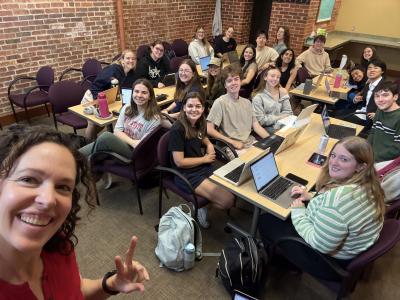
In partnership with Prof. Dr. Hatice Deniz Yükseker Tekin, 25 Ohio State students and 30 IEÜ students met six times over Zoom during the second half of the semester, forming small groups that also met on their own time. Each group chose an immigration-related topic and collaborated on the research, final report, and presentation, drawing comparisons between the United States and Turkey – or, more specifically, between Columbus and İzmir.
One group compared Afghan immigrant businesses on Bethel Road in northwest Columbus with Syrian immigrant businesses in the Basmane neighborhood of İzmir, and found that in both contexts migrants engage in placemaking, using affordable spaces to build support networks. As the students concluded, in both places immigrant communities turn underused or neglected urban spaces into lively neighborhoods filled with economic and social energy. Other groups examined migration among women, the mental health of immigrant youth, refugee policy, border security, media representations of immigrants, and the impact of political narratives on public perception.
Students reported that the seven-hour time difference and differing communication styles were real challenges – and that working through them was the point. They came away more aware of their own cultural assumptions and more practiced at intercultural collaboration. One student reflected:
“This project challenged my preconceived notion of success and made me reconsider how communication and expectations are different in different cultures. At the beginning I viewed a successful project as producing a clean, clear final report in which people split work within defined roles. I realized that success is not always defined that way, and the goal of COIL is not necessarily purely the report but the experience of the project. Maintaining group relationships and remaining flexible throughout the interactions actually taught me how to better approach teamwork.” – Ohio State student, SOC 3200
Dr. Schoon has championed COIL at Ohio State for the past four years and recently led a COIL Learning Community of faculty, supported by the Office of International Affairs and the Drake Institute for Teaching and Learning. COIL is an accessible route to an international experience and to real gains in intercultural competence – and she will offer it again in Spring 2027.